The Complete Guide to Working Legally in Spain as an Expat in 2026
Hi! I'm Andreina, and if you're reading this, you're probably at that stage where uncertainty about paperwork keeps you up at night. I completely understand, because I've been there too.
I'm excited to share some news with you: Spain accepts expired Venezuelan passports for immigration procedures starting January 2025. This has greatly facilitated the migration process for our community.
In this guide, I will explain every document, procedure, and cost required for you to work legally, with specific information for Valencia and updated according to the new Immigration Regulations (RD 1155/2024) effective from May 2025.

What you need to know before starting
The complete process requires between €750 and €2,600 depending on whether you need to homologate university degrees and reunite family. The fundamental procedures must be carried out in this order: registration (empadronamiento), NIE/TIE, bank account, Social Security registration.
As international residents, we have two incredible advantages: a preferential path to Spanish nationality (only 2 years of legal residency) and currently we receive 98.89% favorable resolutions for international protection applications.
If you want us to help you through this process, at [Raíces Valencia we offer
personalized immigration consulting](/servicios/consultoria-migratoria-valencia) so you don't have to navigate all this alone.
---
Registration (Empadronamiento) is the first mandatory step upon arrival
The Municipal Register (Padrón Municipal) is the administrative record containing all residents of a municipality, regardless of their nationality or legal status. For any international resident, registration is the essential prerequisite to apply for the NIE/TIE, access the public health system, apply for "arraigo" (rooting residency), enroll children in school, and eventually apply for Spanish nationality.
I recommend you read our complete guide on registration in Valencia where we explain the process in full detail.
Process in Valencia
The Valencia City Council manages registrations through the Citizen Service Offices (OIAC). The main office is in Plaza del Ayuntamiento (Periodista Azzati, 2), operating Monday to Friday from 8:30 to 14:00. Other offices include Tabacalera (Amadeu de Savoia, 11), Marítim (Barraca, 53), and Russafa (Maties Perelló, 5).

Prior appointment: Can be requested at www.valencia.es → Cita previa → "PADRÓN CP", or by calling 010 (from Valencia) or 96 310 00 10 (from outside Valencia).
Required documentation
To register with a rental contract, you need: passport (valid or expired for Venezuelans), rental contract with a minimum duration of 6 months, rent receipt for the last 2 months, and the cadastral reference of the property.
Without a contract, you can present a written authorization from the owner along with their ID and property title. Valencia allows registration in special situations through the PA.GP.65 procedure for people without a fixed address.
The procedure is completely free and, if the documentation is complete, it is resolved immediately. International residents without permanent residency must renew their registration every 2 years or risk automatic expiration.
---
The NIE is an identification number, not a residence permit
This is one of the most confusing concepts. The Foreigner Identification Number (NIE) is a personal alphanumeric code (format X-1234567-A) assigned by the National Police. It is essential to open bank accounts, sign work contracts, pay taxes, and carry out any administrative procedure in Spain.
However, the NIE alone does not authorize you to reside or work in the country. It is just a tax identification number.
Types of NIE that actually exist
| Type | Description | Validity | Authorizes residency? |
|------|-------------|---------|----------------------|
| White NIE | A4 paper certificate for specific procedures | 3 months | No |
| Green NIE (CUE) | Registration Certificate for EU citizens | Permanent | Yes (EU only) |
| TIE | Physical card for non-EU citizens | According to authorization | Yes |
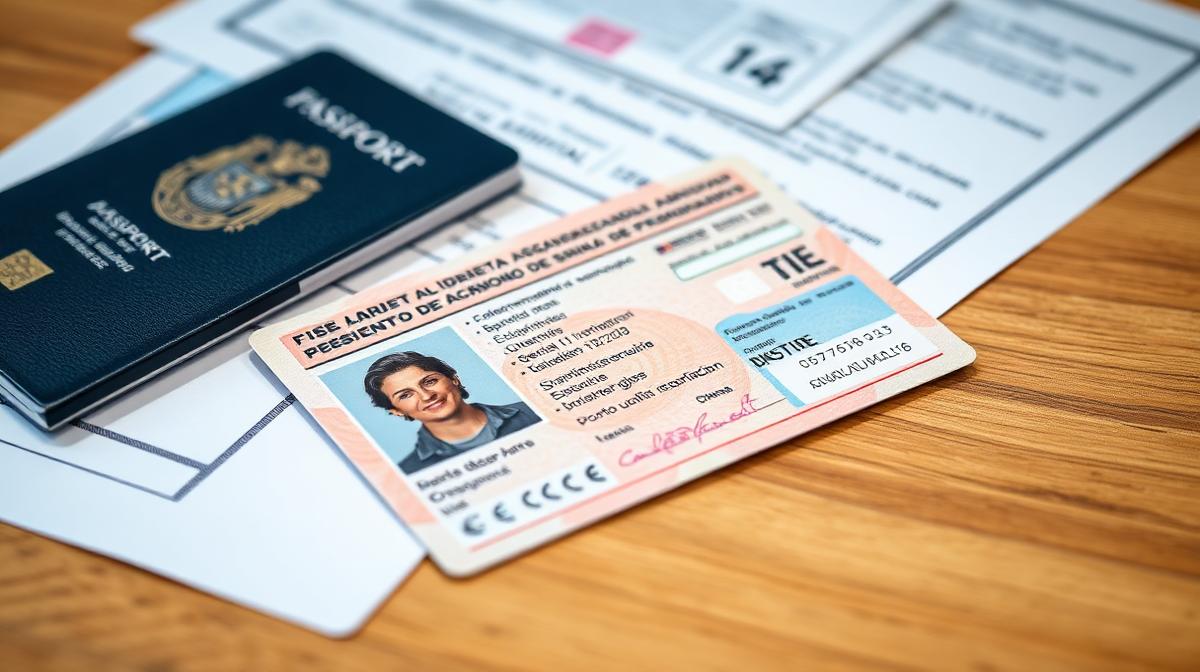
For expats, the NIE appears printed on the TIE (Foreigner Identity Card), which is the document that proves your legal residency status.
Application process
A prior appointment is mandatory and is requested at the Electronic Headquarters. Form EX-15 is required, proof of payment for fee 790 code 012 (€9.84), original passport and copy, and documentation justifying the reason for the application.
The resolution period is 5 working days, although in many cases it is issued on the spot. The assigned NIE number is lifelong and never changes; what is renewed is the document or card where it appears.
---
The TIE documents your legal status in Spain
The Foreigner Identity Card (TIE) is the physical document that proves legal stay for non-EU citizens with a stay authorization exceeding 6 months. It includes a photograph, fingerprints, type of authorization, and expiration date.
The TIE must be applied for within 1 month of entering Spain (if you already have a visa) or from the notification of a favorable residency resolution.

Documents for the TIE
- Form EX-17
- Valid or expired passport (for those relocating from Venezuela)
- Authorization resolution
- Passport-sized photograph
- Fee payment between €12 and €21.87 depending on the type of authorization
The issuance of the physical card takes between 20 and 40 working days after fingerprinting, varying significantly depending on the province.
---
"Arraigo" permits are the main path to legalizing your status
The new Immigration Regulations (RD 1155/2024) reduced the required period of stay from 3 to 2 years for most "arraigo" modalities. This is incredible news for our community!
Comparison of "arraigo" types
| Modality | Time required | Main requirement | Authorizes work? |
|-----------|------------------|---------------------|-------------------|
| Socio-laboral | 2 years | Employment contract (≥20h/week) | Yes |
| Social | 2 years | Family ties + integration report | Yes |
| Socio-training | 2 years | Vocational training (50% in-person) | Yes (up to 30h/week) |
| Family | 2 years | Parent of a Spanish minor | Yes |
Socio-laboral arraigo: the most accessible option
This new category allows you to obtain residency and work with 2 years of continuous stay in Spain and one or more employment contracts that guarantee at least the Minimum Interprofessional Wage (€1,134/month in 2025) with a minimum work week of 20 hours. Unlike the traditional social arraigo, it does not require a Social Integration Report.
Concatenated contracts, seasonal jobs, permanent-discontinuous contracts, and even multiple employers simultaneously are allowed, as long as the sum meets the minimum requirements.
The fee is €38.28 (form 790 code 052) and the authorization is valid for 1 year, renewable for an additional 4 years.
---
The Social Security number is different from the NIE
The NUSS (Social Security Number) or NAF (Affiliation Number) is the 12-digit identifier that the General Treasury of Social Security assigns to manage contributions, benefits, unemployment, and access to the health system. It is mandatory to work legally and remains the same for life.
Who must process it
For employed workers, the employer is obliged to process the registration and assign the NUSS if you don't have one. However, anyone can apply for it personally before getting a job, which is useful to demonstrate to future employers that you are registered in the system.

Documentation and process
Form TA.1, current NIE or TIE (mandatory for non-EU citizens), and a photocopy of the document are required. The application can be made in person at TGSS offices with a prior appointment or through the Importass portal using Cl@ve, digital certificate, or even a selfie with a photo of the NIE.
The number is assigned immediately in most cases. There is no physical Social Security card as such; the NUSS appears on the health card of the Autonomous Community, work contracts, payrolls, and the downloadable report from Importass.
---
Bank accounts: options for newcomers
Although it is not legally mandatory to have a Spanish account to work, it is practically indispensable because most companies pay by bank transfer and you need to direct debit bills.
Comparison of banking options
| Bank | Accepts without NIE? | Free account | Spanish IBAN | Bizum |
|-------|------------------|-----------------|--------------|-------|
| Revolut | ✅ Yes | ✅ Standard Plan | ✅ | ✅ |
| N26 | ❌ Requires NIE | ✅ | ✅ | ✅ |
| Wise | ✅ Yes | ❌ (€7 card) | ✅ | ❌ |
| CaixaBank HolaBank | ❌ Requires NIE | ✅ | ✅ | ✅ |
| BBVA/Santander | With non-resident certificate | ❌ (€5-15/month) | ✅ | ✅ |
Recommended sequence: Open Revolut or Wise immediately with passport → Process NIE → Open a traditional Spanish account or N26.
If you are looking for accommodation while you get your paperwork sorted, we can help you with our apartment search in Valencia.
---
Degree homologation is only mandatory for regulated professions
Homologation recognizes that a foreign degree is equivalent to a Spanish one that grants access to a regulated profession. Equivalence only recognizes the academic level (Bachelor's or Master's) for curricular purposes, public examinations, or continuing studies, but does not allow you to practice regulated professions.
When do you NEED to homologate?
Regulated professions that require mandatory homologation include: medicine, nursing, dentistry, pharmacy, veterinary medicine, physiotherapy, health psychology (with additional master's), architecture, all higher and technical engineering, teaching, and law (with additional access master's).
To work in the private sector in non-regulated professions such as marketing, human resources, design, business administration, or general IT, homologation is not required. Many Spanish tech companies only ask for a CV and an interview.
Updated homologation costs
| Concept | Cost |
|----------|-------|
| Official homologation/equivalence fee | €166.50 |
| Sworn translations (3 documents) | €100-400 |
| Apostilles (if processed in Spain) | €180 (€60 × 3) |
| Approximate total | €300-800 |
The procedure is 100% electronic through the Valida-TE portal of the Ministry of Science. The legal term is 6 months, but in practice, files take between 12 and 24 months.
---
Spain accepts expired Venezuelan passports
The Joint Instruction of January 13, 2025 restored the validity of expired Venezuelan passports for processing and renewing residency permits, work authorizations, and issuing the TIE. This measure recognizes the practical difficulty of renewing passports at Venezuelan consulates.

Important: An expired passport cannot be used to enter Spain (airlines and border control require a valid travel document), but it can be used for all procedures once inside Spanish territory. The instruction does not establish a limit on the years of expiration.
---
Documents you should apostille before leaving Venezuela
The Hague Apostille validates the authenticity of public documents between signatory countries of the convention. Venezuela remains a member, so its apostilled documents are valid in Spain without additional procedures.
Essential list to apostille
- Birth certificate (after legalization at SAREN)
- Marriage certificate (if applicable)
- Baccalaureate diploma (legalized at Zona Educativa)
- University degree (legalized at GTU if it is a public university)
- Academic transcripts/university curriculum
- Criminal record certificate (can be done online with free electronic apostille)
- Divorce decree (if applicable)
- Documents for minor children
From Spain: The SLAE System allows apostilling in consulates in Madrid, Barcelona, Bilbao, Tenerife, and Vigo. Cost: €60 per document (minors under 18 exempted). Criminal record certificates can be processed entirely online with a free electronic apostille.
---
Optimal timeline: what to do and when
Before leaving your home country (1-3 months)
Weeks 1-4: Legalize documents at relevant authorities (civil registration, educational authorities). Schedule an appointment with the apostille service (SLAE for expats from Venezuela).
Weeks 5-8: Apostille all documents. Request criminal records online and get them electronically apostilled. Renew passport if possible. Organize certified copies of everything.
Upon arrival in Spain (first 30 days)
| Days | Priority actions |
|------|----------------------|
| 1-7 | Immediate registration (empadronamiento) + Open Revolut/Wise account |
| 7-15 | Obtain a Spanish phone number + Request NIE/TIE appointment |
| 15-30 | Formalize asylum application (if applicable) + Open traditional bank account |
---
International protection: 98.89% of Venezuelan applications receive favorable resolution
Expats from Venezuela account for 59% of all international protection applications in Spain. In 2025, Spain granted approximately 49,473 humanitarian residency authorizations, of which 99.4% were for Venezuelan citizens.
The asylum application must be submitted within the first month of arrival, at police stations, immigration offices, airports, or CIEs (Foreigner Internment Centers). The "white sheet" is obtained with a temporary NIE that allows working after 6 months.
Important change from May 2025: The time as an asylum seeker no longer counts towards "arraigo" requirements. However, those with a firm negative resolution can access "arraigo" with only 6 months of residency (1-year transitional measure).
---
Estimated total costs for the complete process
Official immigration fees (updated June 2025)
| Procedure | Cost |
|---------|-------|
| NIE assignment | €9.84 |
| TIE first issuance | €16.08 |
| TIE renewal | €19.30 |
| Arraigo (any modality) | €38.28 |
| Work authorization for employee | €203.84 - €407.71 |
Budget by scenarios
Basic scenario (1 person, no degree homologation):
- Apostilles (4-5 documents): €240-300
- Translations: €100-200
- NIE + TIE: €26
- Annual health insurance: €400-600
- TOTAL: €750-1,150
Complete scenario (with homologation and family reunification):
- Apostilles: €300-400
- Translations: €200-400
- Immigration fees: €50-100
- Degree homologation: €166.50
- Health insurance: €800-1,500
- TOTAL: €1,500-2,600
---
Common mistakes you absolutely must avoid
Documentation: Not apostilling documents before leaving your home country is the most costly and difficult mistake to remedy. Forgetting to legalize degrees at the corresponding instance before apostilling invalidates the process.
Critical deadlines: Not applying for asylum within the first month of arrival closes that avenue. Not renewing registration every 2 years (mandatory for international residents without permanent residency) causes automatic expiration. Being outside Spain for more than 6 months with temporary residency can invalidate the authorization.
Common scams to avoid
- "Gestores" (administrative agents) who charge for free procedures like empadronamiento
- Promises to "speed up" files without being able to do so
- False work contracts for arraigo purposes
- Fraudulent apostilles (detectable and with criminal consequences)
How to protect yourself: Always use official channels (Electronic Headquarters, consulates). Consult with specialized NGOs such as ACNUR, Cruz Roja, or CEAR. Verify lawyer registration with professional associations. Do not pay full advances and demand written receipts.
---
Conclusion
The process for working legally in Spain as an expat is more accessible than ever thanks to the acceptance of expired passports, the reduction of the "arraigo" period to 2 years, and the high approval rate for international protection.
The key to success is to apostille all documents before leaving your home country, follow the correct order of procedures (empadronamiento first), and avoid unofficial intermediaries.
With a budget of €750-1,500 and proper planning, the complete process from arrival to regularization can be completed in 3-6 months for international protection routes, or in 2 years for "arraigo".
Spanish nationality is available for expats after only 2 years of legal residency, one of the fastest paths to European citizenship in the world.
Do you need personalized help with your immigration process? Contact us and we will accompany you every step of the way.