3 days in Valencia: a day-by-day itinerary and local tips
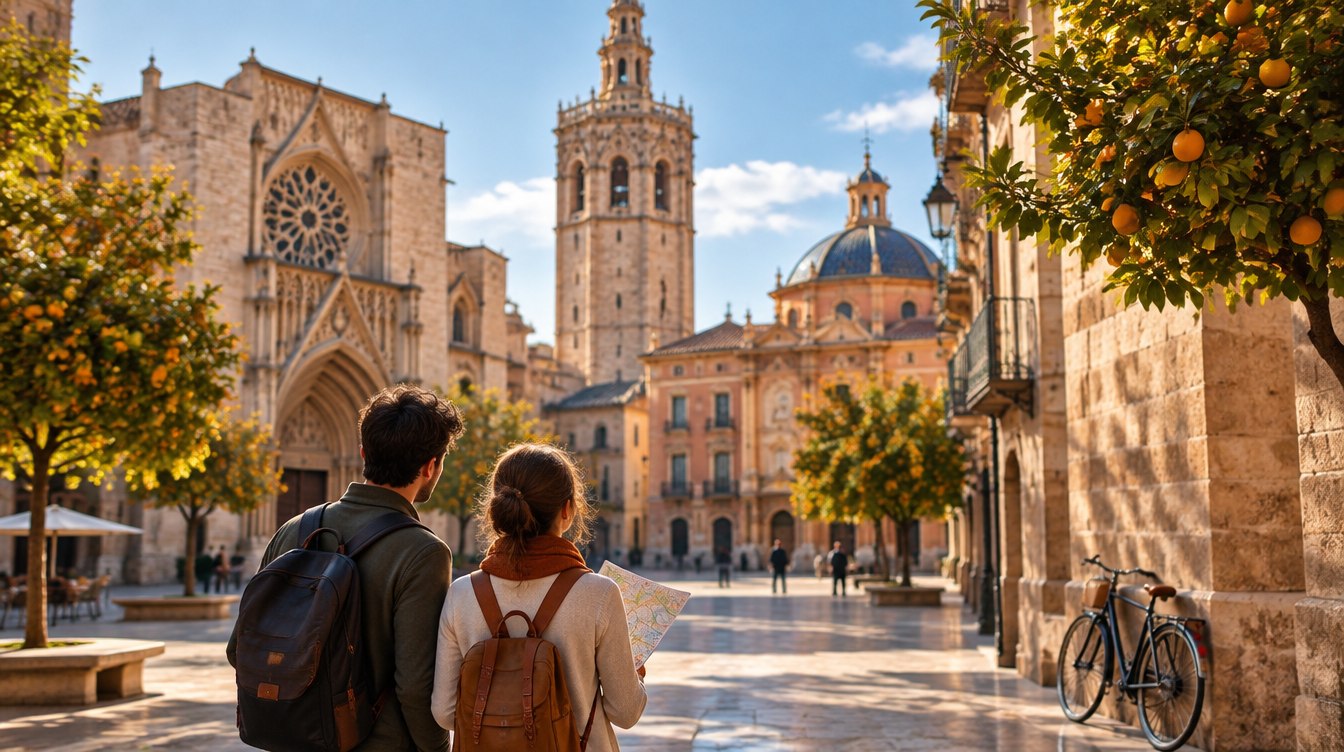
Three days are enough to see the best of Valencia: on day one, walk the old town (Torres de Serranos, the Cathedral and Micalet tower, the Silk Exchange, the Central Market and El Carmen); on day two, cycle the Turia Gardens to the City of Arts and Sciences and spend the evening in Ruzafa; and on day three, head for the sea: Cabanyal, Malva-rosa beach and a paella lunch in El Palmar, with a boat ride on the Albufera lake at sunset.
This is the route we give friends and family who come to visit, and the people who spend a few days in Valencia deciding whether to move here. Each day has its own map, the opening hours and prices we checked on the official websites, and the kind of tips you only get from someone who lives here.
The itinerary at a glance
| Day | Area | Highlights | Getting around |
|---|---|---|---|
| 1 | Old town (Ciutat Vella) | Torres de Serranos, Cathedral and Micalet, Silk Exchange, Central Market, El Carmen, Torres de Quart | On foot, about 2 km |
| 2 | Turia and Ruzafa | Turia Gardens, City of Arts and Sciences, dinner in Ruzafa | Bike (Valenbisi) and on foot |
| 3 | The sea and the Albufera | Cabanyal, Malva-rosa beach, paella in El Palmar, sunset boat ride | Tram or bus, then bus 25 or a taxi to El Palmar |
Day 1: what to see in Valencia's old town
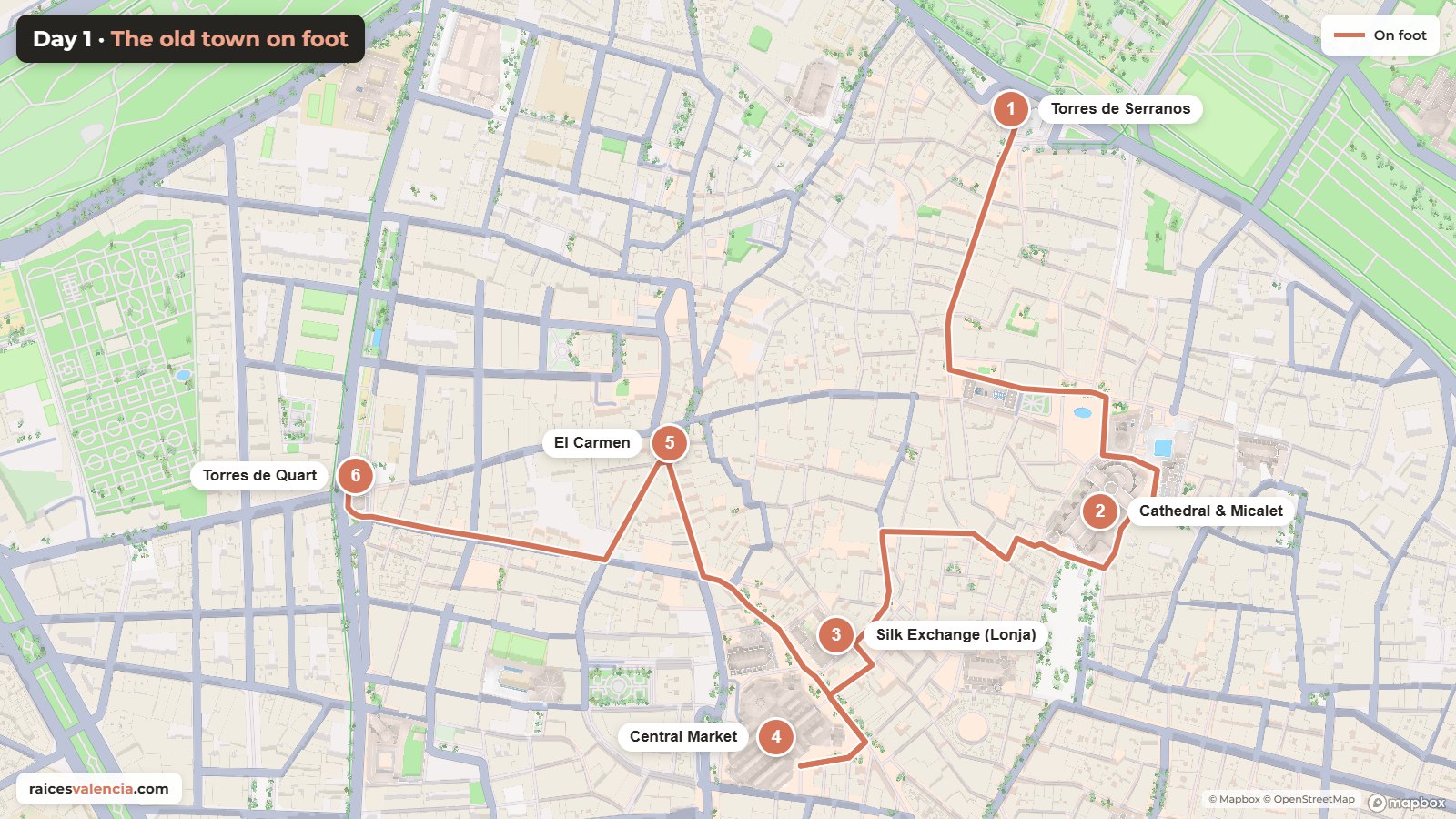
Day one is entirely on foot: about 2 km from stop to stop, along narrow streets with hardly any cars.
1. Torres de Serranos (10:00). This was the main gate of the medieval city wall, and from the top you look over the Turia Gardens and the rooftops of the centre. Entry is €2 and free on Sundays and public holidays. Open Monday to Saturday 10:00–19:00, and 10:00–14:00 on Sundays and holidays.
2. Plaza de la Virgen, the Cathedral and the Micalet. The Cathedral ticket costs €12 and includes an audio guide; inside is the Chapel of the Holy Chalice, which the Cathedral venerates as the Holy Grail. The Micalet bell tower is a separate ticket: €3 and 207 steps to one of the best views in the city. From October to June, the Cathedral opens Monday to Friday 10:30–18:30, Saturday 10:30–17:30 and on Sundays only from 14:00 to 17:30.
3. Silk Exchange (La Lonja de la Seda). The finest Gothic civil building in Valencia, and a UNESCO World Heritage Site since 1996. Look up in the hall of columns, which twist like palm trees. €2 (free on Sundays and holidays), same hours as the towers.
4. Central Market. It sits right opposite the Silk Exchange. Come before lunch: it opens Monday to Saturday 7:30–15:00 and is closed on Sundays and public holidays. A good place to try cured meats and local fruit, or grab something at one of the counters.
5. El Carmen. After lunch, get lost in this neighbourhood: street art on the walls, small squares and pieces of the old Moorish wall hidden between buildings. Plaza del Tossal is a good place to start.
6. Torres de Quart. End the day at the other great gate of the wall, which still shows the marks of cannon fire from the Peninsular War. Same price and hours as Serranos.
Local tip: if your first day falls on a Sunday, swap it with day two. On Sundays the Central Market is closed and the Cathedral only opens in the afternoon. On the plus side, the towers and the Silk Exchange are free.
Day 2: how to see the Turia Gardens and the City of Arts and Sciences
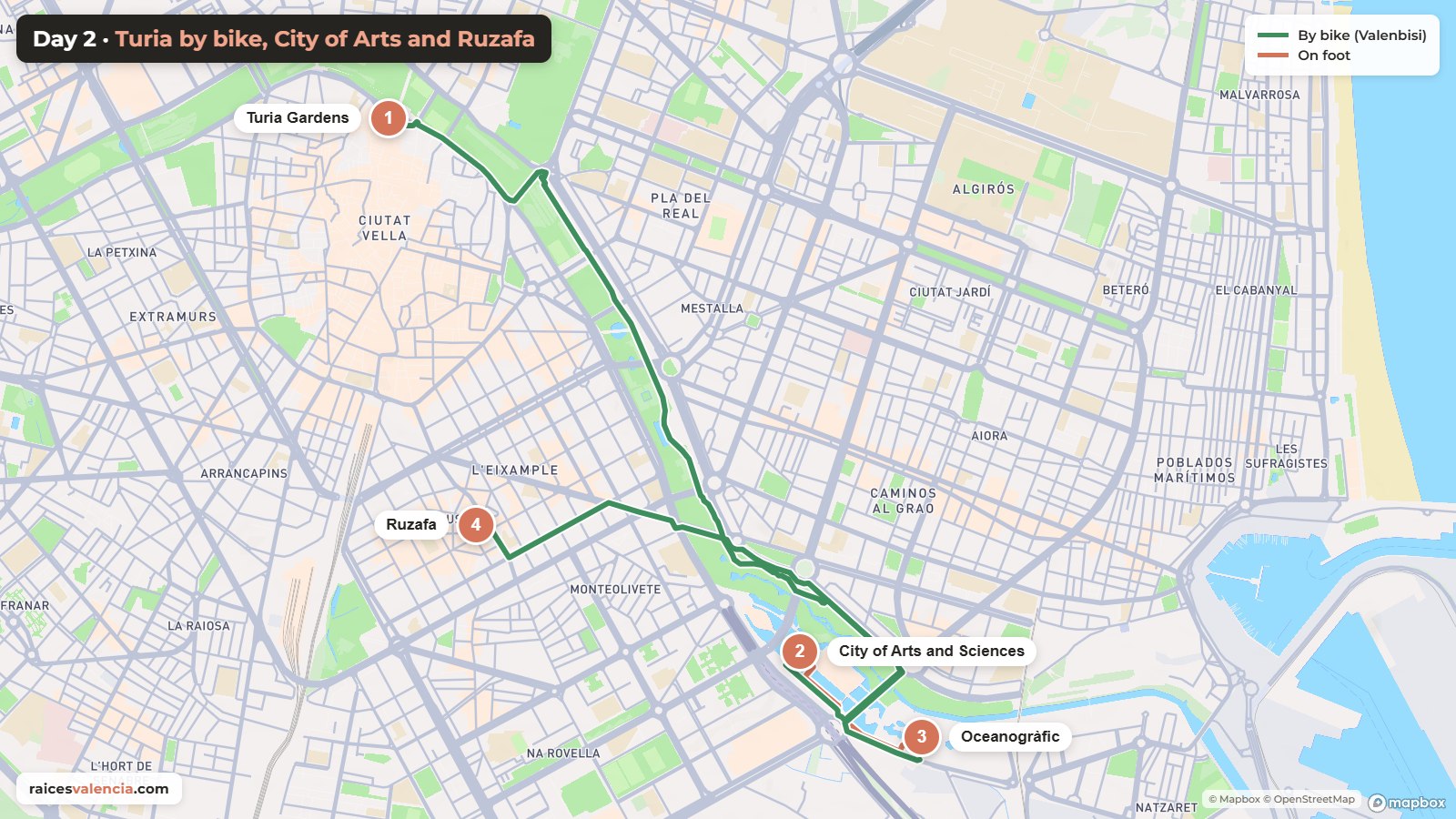
1. The Turia Gardens by bike. Valencia diverted its river after the 1957 flood, and the old riverbed is now a 9 km park running right through the city. Pick up a Valenbisi bike near Torres de Serranos and ride down the riverbed to the City of Arts and Sciences: about 20 minutes at an easy pace, with no traffic and plenty of shade. The short-term pass costs €13.30 for 7 days; you sign up on the website or the app, and the first 30 minutes of every ride are free. Dock the bike before the half hour is up and take it out again, and you won't pay extra.
2. The City of Arts and Sciences. Walking around Calatrava's buildings costs nothing, and it is where you will take most of your photos. If you want to go inside, choose: one day is not enough for everything.
| Option | Adult price | Best for |
|---|---|---|
| Oceanogràfic | €35.90 to €43.05, depending on the date | Aquarium lovers. Allow half a day |
| Science Museum (Museu de les Ciències) | From €9.90 | Families with children, or a rainy day |
| Oceanogràfic + Science Museum + Hemisfèric | €44 to €51.25 | Seeing it all and making a day of it |
Buy your ticket on the official website before you go: prices change by date.
3. Ruzafa in the evening. Ride or walk back (about 2.5 km) to Ruzafa, Valencia's trendiest neighbourhood: cafés, restaurants from all over the world and terraces full until late. It is the best place for dinner. The local market only opens in the mornings, currently with shorter hours because of building work; if you want a horchata on the way, the Mercado de Colón stays open into the night.
Day 3: what to do in Cabanyal, on the beach and in the Albufera
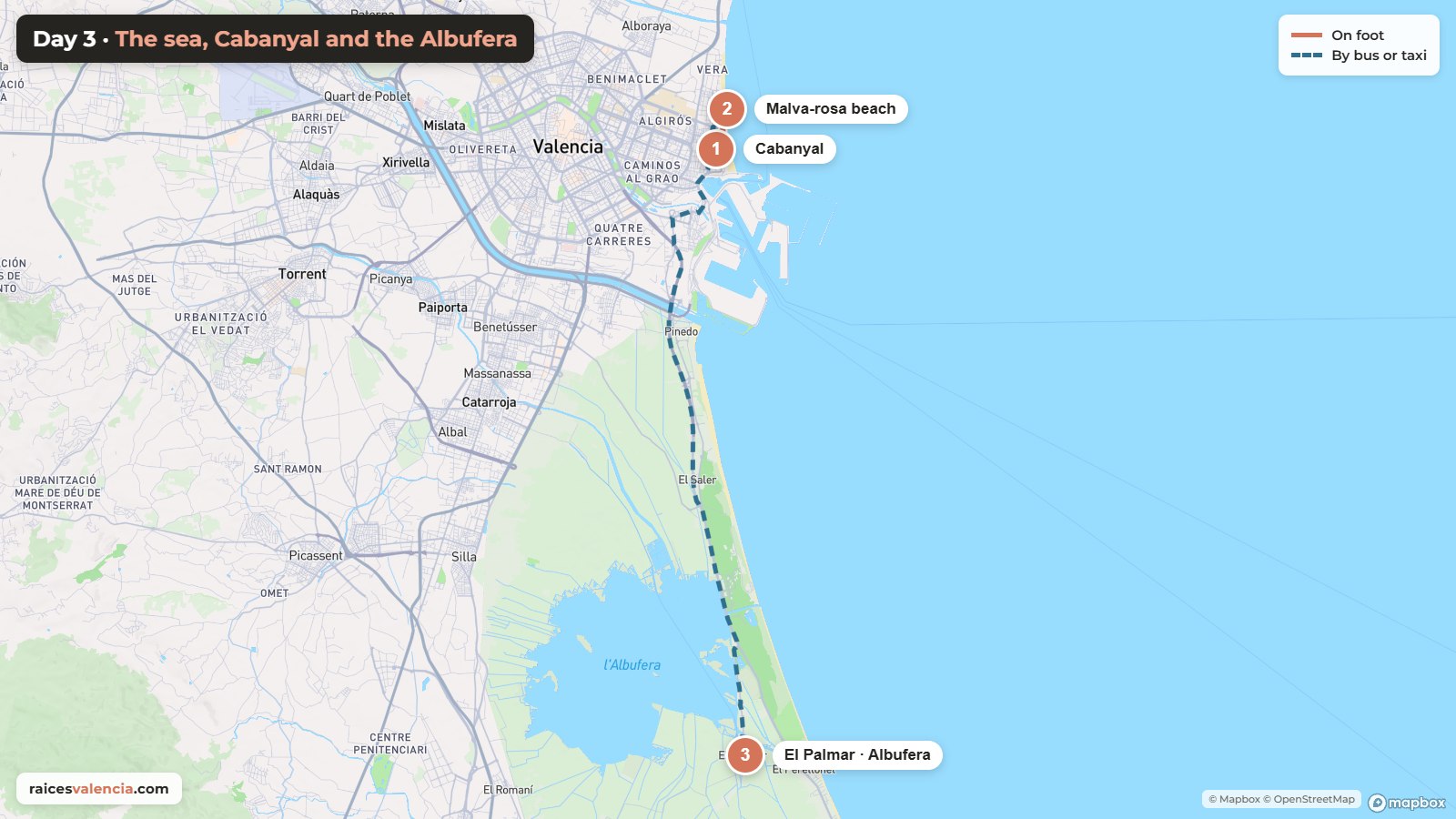
1. Cabanyal (morning). The old fishermen's quarter, with low houses and colourful tiled façades, each one different. You can get there from the centre by tram, bus or bike.
2. Malva-rosa beach. Two streets from Cabanyal, the seafront promenade begins. Even outside swimming season, the promenade is part of everyday life in Valencia: runners, terraces and a wide stretch of sand.
3. El Palmar and the Albufera (lunch and afternoon). El Palmar is a fishing village inside the Albufera Natural Park, about 20 km from the centre, and it is known as the birthplace of paella. Take EMT bus 25 from Porta de la Mar (a single ticket is about €2) or a taxi from the beach. Check the times in the EMT app, as the bus runs every 25 to 30 minutes.
Have your paella here, and try all i pebre too, an eel stew typical of the Albufera. In the afternoon, take a boat ride: it lasts about 40 minutes, and sunset over the lake is the most beautiful and most popular time, so book ahead. Boat-and-paella packages start at €26.
Local tips for your trip to Valencia
- Paella is a lunch dish. In Valencia nobody eats it for dinner. If a restaurant offers it to you at nine in the evening, be wary.
- Horchata with fartons. Tiger nuts are grown in the farmland around Alboraya, home to the regulatory council of the Denominación de Origen. If you have time, go there; if not, there are horchata bars all over the centre.
- Sundays and free entry. Torres de Serranos, Torres de Quart and the Silk Exchange are free on Sundays and public holidays. The Fine Arts Museum (Museo de Bellas Artes) is always free (Tuesday to Sunday, 10:00–20:00) and is the best plan on a rainy day.
- The Valencia Tourist Card. The 72-hour card costs €30 (€27 online). It covers public transport, including the metro to the airport, free entry to 14 municipal monuments and up to 50% off at the City of Arts and Sciences. It pays off if you will use public transport a lot and visit the City of Arts and Sciences.
- From the airport to the centre. The metro (lines 3 and 5) takes about 20 minutes. A single ticket costs €4.80 (zone AB+) plus €1.10 for the rechargeable cardboard SUMA card.
- Watch out for pickpockets. Valencia is a safe city, but at the Central Market, in Plaza de la Virgen and on the metro, keep your phone and wallet in front of you. We go through the data in Is Valencia safe?
Visiting to decide whether to move to Valencia?
Many of the people who write to us make this trip with another idea in mind: trying out the city before moving here. If that is you, use the afternoon of day three, or add an extra morning, to walk around the neighbourhoods where you could actually live, not just the tourist areas. Our guide to the best neighbourhoods to live in Valencia will help. And when you are ready, at Raíces we find your rental apartment and help you with the paperwork when you arrive.
Frequently asked questions
Are 3 days enough to see Valencia?
Yes, for the essentials. In three days you can see the old town, the Turia Gardens, the City of Arts and Sciences, Cabanyal, the beach and the Albufera without rushing. What you leave out is time in the museums, the surrounding villages and day trips such as Sagunto or Xàtiva, which need a fourth day.
How much does a 3-day trip to Valencia cost?
Following this itinerary, about €70 per person in tickets and bike hire: €21 for the towers, the Cathedral, the Micalet and the Silk Exchange, €35.90 for the Oceanogràfic on its cheapest date and €13.30 for the Valenbisi pass. On top of that come meals, accommodation, transport and the Albufera boat. On Sundays you save on the towers and the Silk Exchange.
Is the Valencia Tourist Card worth it?
It depends on how much you use public transport. The 72-hour card costs €30 (€27 online) and covers metro, buses and trams, including from the airport, entry to 14 municipal monuments and up to 50% off at the City of Arts and Sciences. If you walk everywhere and skip the Oceanogràfic, you don't need it.
How do you get from Valencia airport to the city centre?
By metro, on lines 3 and 5, which take about 20 minutes to the centre and run every 15 to 20 minutes. A single ticket costs €4.80 (zone AB+) plus €1.10 for the SUMA card. There is also the slower Metrobus 150, which stops near the Central Market.
How do you get to the Albufera by public transport?
Take EMT bus 25, which leaves from Porta de la Mar in the centre and runs via El Saler to El Palmar. It comes every 25 to 30 minutes and a ticket costs about €2. Check the return times in the EMT app before you go, especially if you are staying for the sunset.
What to do in Valencia when it rains?
Swap the days around and save the indoor plans for the rainy one: the Fine Arts Museum, which is free; the Science Museum or the Oceanogràfic; the Cathedral; and the Central Market or the Mercado de Colón for lunch. Cycling the Turia and the Albufera are better in the sun.
When is the best time to visit Valencia?
Spring and autumn, with mild temperatures and less heat than in summer. Valencia has an annual average of 18.3 °C and around 2,696 hours of sunshine a year, according to AEMET, Spain's weather agency. If you come between 15 and 19 March, you will catch Las Fallas: see our Fallas guide and book your accommodation well in advance.